🌿 Cladotherian
Therian Types & Shifting Styles
By the Inner Therian team · Last updated October 10, 2026
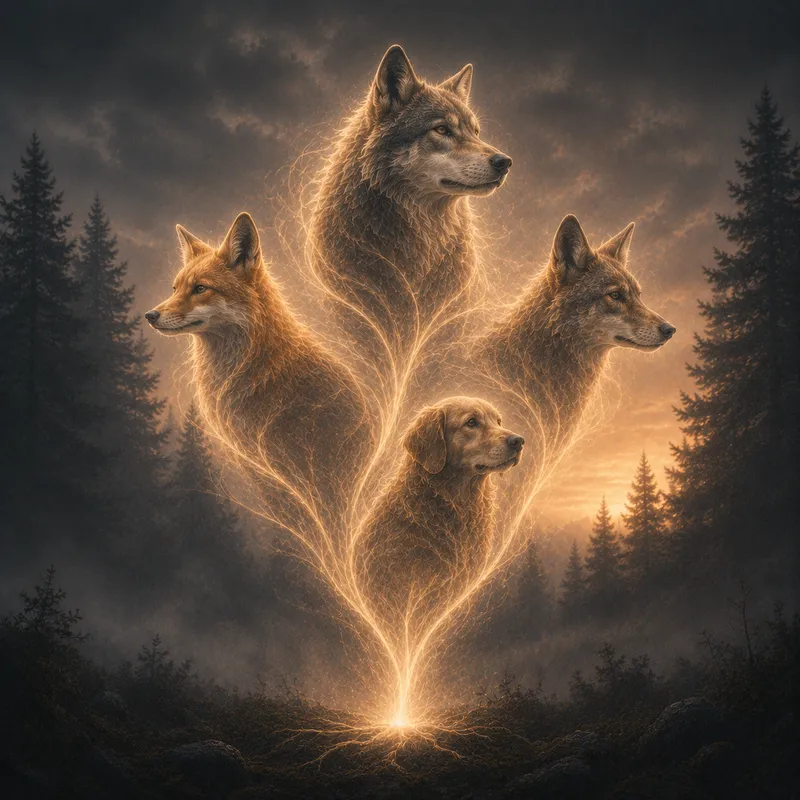
A cladotherian identifies with an entire clade — a whole family or group of related animals (like all canines or all felines) — rather than one exact species.
From the Greek klados ("branch") and therion ("animal"), cladotherianthropy is for therians whose sense of self spans a group of animals. The "type" of animal matters more than pinning down a single species — a cladotherian canine might feel wolf, dog, fox, and coyote all at once.
What a "clade" means in biology
In biology, a clade is a group made up of a common ancestor and all of its descendants — one whole branch of the tree of life. All dogs, wolves, foxes and coyotes, for example, belong to the family Canidae, which descends from a shared ancestor.
Cladotherians borrow this idea to describe identifying with a branch rather than a single twig. The "level" of the branch varies from person to person: some feel like a broad family such as felines, others like a narrower group such as the big cats of the genus Panthera.
Common clades and what they share
Cladotherians often describe their identity through traits the whole group has in common, rather than details unique to one species. A few examples:
| Group | Includes | Shared traits people often relate to |
|---|---|---|
| Canids (Canidae) | Wolves, dogs, foxes, coyotes, jackals | Scent-led attention, endurance, expressive ears and tails, social signalling |
| Felids (Felidae) | House cats, lions, tigers, leopards, lynx | Stalk-and-pounce hunting, retractable claws in most species, stillness and precision |
| Corvids (Corvidae) | Ravens, crows, jays, magpies | Curiosity, problem-solving, strong memory, vocal variety |
| Mustelids (Mustelidae) | Otters, weasels, badgers, wolverines | Long flexible bodies, high energy, playful persistence |
A cladotherian canid might relate to being a scent-driven, social, expressive animal without feeling any pull toward wolf specifically over fox.
Cladotherian or "not sure of my species yet"?
Lots of therians go through a stage of knowing they're "some kind of canine" or "some kind of bird" before the picture sharpens. That's different from being a cladotherian, though the two can look similar from the outside.
- Still narrowing down: you have a sense that there's a specific animal, you just haven't recognized it yet.
- Cladotherian: you've reflected on it and the group itself is the answer — narrowing it down feels wrong, not just unfinished.
There's no deadline for working out which one applies. Plenty of people use "canine therian" or "feline therian" comfortably for years. The theriotype quiz can offer a starting point if you want to explore.
How it differs from polytherian
A polytherian holds two or more distinct theriotypes, each felt individually. A cladotherian feels one shared identity that happens to cover many species.
Imagine someone who relates to wolves, foxes and coyotes. If each feels separate — a wolf side, a fox side — that leans polytherian. If they blur into one feeling of simply being canid, that leans cladotherian. Some people end up somewhere between and describe themselves however feels most honest.
A note on everyday groupings
Not every familiar animal category is a clade in the strict scientific sense. "Birds of prey" is a good example: hawks and eagles are closely related to each other, but genetic studies show falcons are actually closer to parrots and songbirds, and owls form their own separate group. "Big cats" in everyday speech often includes cheetahs, which aren't in Panthera.
That doesn't make the label wrong. Many cladotherians use broad, everyday groups like "raptors" or "big cats", and the community generally cares more about whether the description fits your experience than whether it matches a textbook.
🌟 In Short
- You identify with a whole animal family or clade
- The broad "type" matters more than one exact species
- Common examples: all canines, all felines, all corvids
Cladotherian FAQ
Where does the word cladotherian come from?
It combines the Greek klados, meaning branch, with therian. Biologists use the same root in "clade" and "cladistics", the study of how living things branch from shared ancestors.
Can a cladotherian also have a specific theriotype?
Some people describe a clade identity with one species slightly in front, such as "canid, mostly wolf". Others combine a clade with an unrelated theriotype and also call themselves polytherian. Mixing labels is fine.
How broad can a clade be?
In principle it could be very broad, but most cladotherians describe something like a family (canids, felids, corvids) or a genus. Very broad groups like "all mammals" are rarely used because they do not capture much about the experience.
How do cladotherians experience shifts?
Much like anyone else. Some cladotherians describe shifts that feel broadly canine or feline rather than tied to one species, such as a general urge to sniff the air or stalk. Others are contherian or suntherian and rarely shift at all.
Do I need to know taxonomy to be a cladotherian?
Not at all. Learning about your animals is enjoyable and helps you describe yourself, but the identity comes from self-reflection, not from memorizing scientific names. Browse our theriotype guides if you want to learn more about individual species.