🦅 Hawk / Bird of Prey
Type: Theriotype (real, earthly animal)
By the Inner Therian team · Last updated October 10, 2026
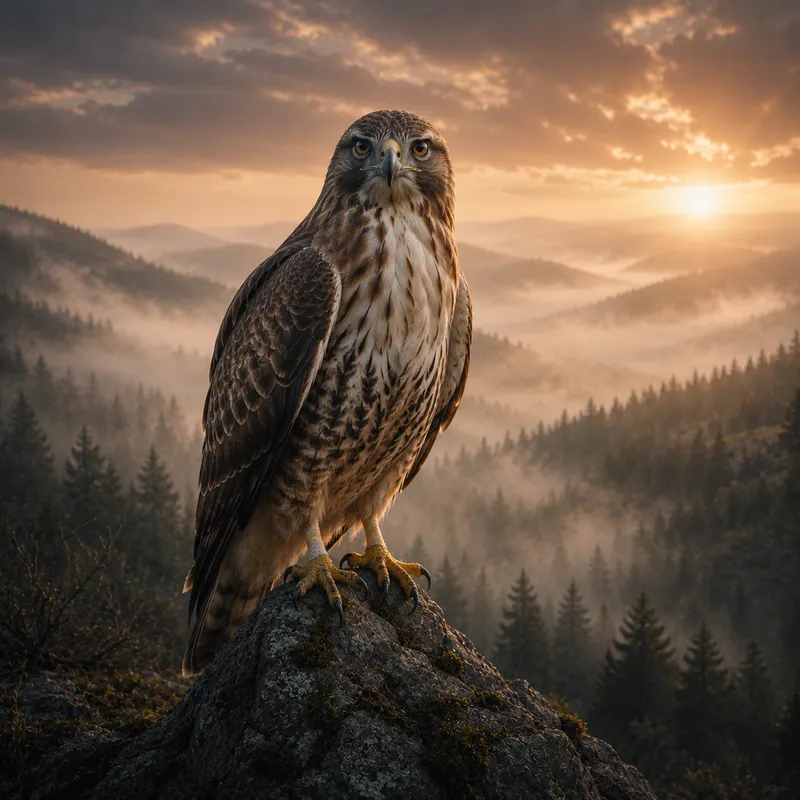
Hawk and other bird of prey therians (eagles, falcons) are sharp-eyed, focused, and drawn to freedom. Avian therians often describe a love of high places, a wide perspective, and a craving for the open sky.
Raptor therians tend to value clarity, independence, and the ability to see the bigger picture. Many experience some of the most distinctive phantom shifts — wings — along with a strong pull toward heights and open air.
Hawks, Eagles and Falcons: Who Counts as a Raptor?
"Bird of prey" covers several groups that look alike but aren't closely related. Hawks, eagles, kites and harriers belong to one family (Accipitridae). Falcons, including the peregrine and the kestrel, belong to a different family. Genetic studies have shown that falcons are actually more closely related to parrots and songbirds than to hawks. They look similar because they evolved for the same job.
That difference shows up in how they hunt:
- Buteos (for example the red-tailed hawk) circle high on rising warm air and drop onto prey on the ground.
- Accipiters (for example Cooper's hawk and the goshawk) have short wings and long tails, and they chase birds through trees with sharp, fast turns.
- Falcons have long, pointed wings built for speed. A diving peregrine falcon is often described as the fastest animal on Earth, reaching more than 300 km/h.
- Eagles are large, powerful hunters, and many eat fish or carrion as well as live prey.
Many raptor therians know their exact species. Others just feel "hawk-shaped" or "falcon-shaped." Both are valid starting points.
Seeing Like a Raptor
Raptor vision is remarkable. The eyes are very large for the size of the head, and the retina has far more light-sensitive cells packed together than a human retina does. Many raptors also have two areas of sharpest focus in each eye: one for looking straight ahead and one for looking off to the side. Like many birds, they can also see ultraviolet light.
Raptors rely much more on sight than on smell. Many raptor therians describe sensory shifts that feel like a sharpened focus: picking out one moving thing in a busy scene, a pull to scan the horizon, or feeling uneasy when they can't see far. Some notice that they tilt or bob their head to judge distance, a little like a bird lining up its view.
Phantom Wings and the Predator Headspace
Wings are among the most commonly described phantom shifts for avian therians. They don't usually feel like "arms with feathers." People more often describe a broad, layered structure across the back and shoulders that wants to open, tuck in or catch the wind. Some feel phantom talons that want to grip, or a tail that feels like it could steer.
Unlike the horse or rabbit, the hawk is a predator. Raptor therians often describe a predator headspace that is calm and patient rather than angry: perching, watching and waiting, then committing completely to one decision. It's often described as cool and focused, not aggressive.
Any predatory shift is still only a feeling. It never needs to be acted out on people or animals. If a shift ever leaves you feeling out of control, step away, ground yourself, and talk to someone you trust. The feral shifts guide has some practical tips.
Hawk Therian Daily Life
- Height seeking. A balcony, a hilltop, or the top seat of a stadium can feel right in a way that's hard to explain.
- Weather awareness. Some raptor therians are very aware of wind and rising warm air on hot days, which are the conditions soaring birds rely on.
- Solitude. Most hawks hunt and roost alone or as a pair outside the breeding season. Many raptor therians say they need a lot of time alone, though they may bond deeply with one or two people.
- Feeling grounded too much. Long stretches indoors can feel like "clipped wings," a restlessness that eases when they see open sky.
Hawk, Owl, Raven or Dragon?
Avian therians sometimes go back and forth between a few birds before settling. Some questions that can help:
- Are you most alive at noon or at midnight? Hawks hunt in daylight. Most owls hunt at night or at dusk, using sound as much as sight.
- Are you a hunter or a problem-solver? Ravens are clever, social songbirds that eat almost anything. Hawks are specialist hunters.
- Does your sense of wings come with scales, horns or something larger than life? That may point toward a draconic identity, which is usually considered otherkin rather than therian.
Reflection Prompts
- When you imagine flying, are you flapping, soaring or diving?
- Do you feel more like a lone hunter or part of a bonded pair?
- Where in your body do phantom wings start: shoulder blades, upper arms, or somewhere else?
- Is the pull toward the sky about freedom, about seeing everything, or about the hunt?
🌟 Signs the Hawk / Bird of Prey Might Be Your Theriotype
- You crave open sky, heights, and freedom
- You're focused and see the bigger picture
- You value clarity and independence
- You experience phantom wings, talons, or a tail
- You feel a pull to high vantage points
🌀 Common Shifts
Avian therians commonly report phantom wing shifts, sensory shifts toward sharp sight, and freedom-seeking mental shifts. Learn more on our shifts guide & quiz.
💚 A Note on Respect
Your theriotype isn't a choice, a phase, or a costume — and only you can truly know it. A quiz like ours can point you toward animals worth reflecting on, but take your time. There's no "fake" therian and no rush. If the Hawk / Bird of Prey resonates, explore it gently through introspection, dreams, and community.
Hawk / Bird of Prey Theriotype FAQ
Can I be a hawk therian if I am afraid of heights?
Yes. Your human body and your theriotype don't have to match on every point. Some avian therians feel a longing for the sky while their human side feels nervous on a ladder. Both can be true.
Are phantom wings real?
Phantom wings are a felt sensation, not physical wings. Therians understand them in different ways: as body-map experiences, as a spiritual sense, or as "I don't know, but it's there." Nobody grows wings, and no one can teach you to.
Does a falcon count as a hawk theriotype?
This page covers raptors in general, but falcons are a separate family from hawks. Many therians name their exact species (peregrine, kestrel, red-tail) once they're sure. Others identify with birds of prey as a group, which is similar to a cladotherian identity.
Is a hawk therian aggressive?
No more than anyone else. A predator theriotype tends to show up as focus, patience and decisiveness. Shifts are internal experiences and should never involve hurting people or animals.
What if I relate to several different birds?
That's common. You might be a polytherian with more than one theriotype, a cladotherian, or still working it out. There's no deadline for figuring it out.